Supplement product video ideas work best when they make an everyday routine visible without turning the ad into a medical promise. This guide is for supplement sellers who want practical scenes they can record with a phone.
A strong supplement video shows the package clearly, demonstrates a simple use moment, and gives one reason to keep watching. Start with a recognizable routine, capture five to seven short clips in consistent light, and write restrained copy around the product’s real label and evidence. Avoid diagnosing problems or promising outcomes.
You will leave with seven concepts, a phone-ready shot list, and a 15-second script template. The approach suits bottles, pouches, powders, gummies, and drink mixes.
Why do supplement product video ideas work?
Supplement ads become easier to understand when viewers can see where the product fits into a real routine. The visual story can answer three practical questions quickly: what is it, how is it used, and what does the package actually say?
According to the CDC’s National Center for Health Statistics (2021), 57.6% of U.S. adults aged 20 and over used a dietary supplement in the previous 30 days in 2017–2018. That broad use means a generic “wellness” montage is rarely enough; the scene should identify a specific routine and audience.
According to the same CDC/NCHS report (2021), reported use was 63.8% among women and 50.8% among men. Those figures do not tell you whom to target by themselves, but they show why audience, life stage, format, and context deserve deliberate creative choices.
7 supplement product video ideas to try
1. Build a morning counter routine
Place the product beside a glass, breakfast bowl, or kettle in soft window light. Film the hand entering, opening the package, preparing the serving exactly as directed, and returning the pack to a clean hero position.
The story is the routine, not a dramatic transformation. Keep the background believable and remove unrelated branded items that compete with your package.
2. Turn the label into the story
Begin on the front of the package, then cut to readable close-ups of the serving information and directions. Finish with the complete product in frame. Do not use an AI-generated label or hide required information behind effects.
Use this format when shoppers routinely ask about form, quantity, ingredients, or directions. Your video should reproduce only what the real package supports.
3. Show texture without making a promise
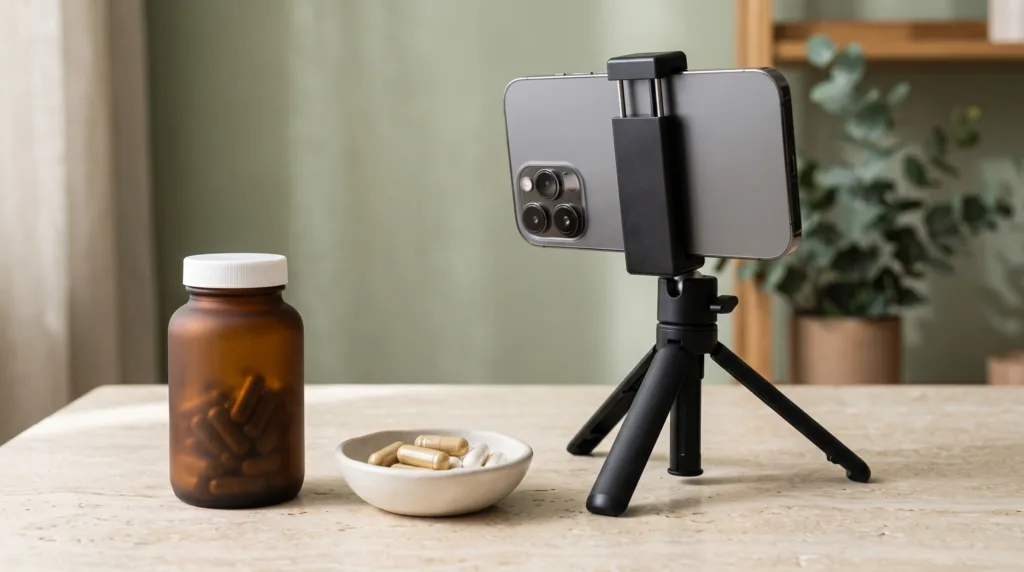
For powders and drink mixes, record the scoop, pour, swirl, and settled drink. For gummies, film shape and texture in macro detail. For capsules, use a controlled tabletop arrangement rather than implying a result inside the body.
Texture gives the edit motion and sensory interest. It also lets you create a useful video without leaning on a before-and-after claim.
4. Make a bag-to-desk sequence
Pack the product into a tote, move to a desk or gym bag, then reveal it again beside an everyday object. Keep the usage scene consistent with the package directions, and avoid suggesting that the product replaces food, sleep, treatment, or professional advice.
Match cuts make this simple story feel intentional: close the cupboard, close the bag, then open the bag at the next location.
5. Answer one customer question
Choose one factual question such as “What form does it come in?” or “How do I store it?” Put the answer in voiceover while the corresponding detail appears on camera. One question per video keeps the message clear.
Use the wording from your approved product information. Save broader FAQs for separate creative variants instead of cramming them into one edit.
6. Create a three-beat packshot reveal
Start with an ingredient-adjacent texture or unbranded prop, reveal part of the package, then show the complete pack in clean light. For example: condensation, a citrus-colored backdrop, and then the bottle. Props should suggest mood, not add claims the label does not make.
If you need a fast alternative to filming every transition, you can turn a product photo into a short ad in Prodvid, our team’s AI product video ads app for iPhone. Check the generated package, proportions, and label frame by frame before publishing.
7. Film an order-packing mini story
Show the sealed product, protective packing, box close, and finished parcel. This gives small brands a credible behind-the-scenes angle while keeping health claims out of the script.
Record real fulfillment details rather than staging unsafe handling. A top-down phone mount makes repeated packing actions easy to capture.
How do you shoot a supplement video on a phone?
Use one window, one background, and one locked exposure. Clean the lens, place the phone on a tripod or stable stack, and record each action as a separate two- to four-second clip. Capture vertical footage if the first destination is a vertical short-form placement.
Plan the sequence before opening the package. The 12-clip product video shot list explains how to collect wide, medium, detail, action, and closing frames without overshooting.
Copyable seven-clip checklist
- Clean front packshot with the full package visible.
- Hand reaches for the product.
- Package opens without obscuring the label.
- Serving or preparation shown according to directions.
- Macro texture or format detail.
- Product in its real use environment.
- Closing packshot with space for platform-safe captions.
Copyable 15-second script
0–2 seconds: “Here is the simplest part of my morning setup.”
2–6 seconds: Show the package and say what the product is, using the approved product description.
6–11 seconds: Demonstrate preparation or serving exactly as the directions state.
11–15 seconds: Show the pack again and give a neutral next step, such as “Read the label for ingredients and directions.”
If the opener feels flat, adapt one of these phone-shot product video hooks while keeping every statement supportable.
How do you keep supplement video claims grounded?
Start with the real label, substantiation files, and the rules that apply where you sell. A pleasing routine cannot turn an unsupported health statement into an acceptable one.
According to the U.S. Federal Trade Commission (2022), health-related advertising claims must be truthful, not misleading, and supported by science. The guidance also explains that advertisers should consider the overall message, including implied claims created by images.
According to the U.S. Food and Drug Administration (2022), the FDA does not approve dietary supplements for safety and effectiveness before they are sold. Avoid “FDA approved” language for a supplement, and have qualified counsel review regulated claims and disclosures for your market.
- Use the exact product name and current packaging.
- Show preparation that matches the directions.
- Remove disease, cure, prevention, and guaranteed-result language unless qualified experts confirm it is lawful and substantiated.
- Do not let props, transformations, or testimonials imply more than the spoken copy says.
- Review every frame for altered labels, missing warnings, and invented ingredients.
FAQ
What should a supplement product video include?
A supplement product video should include a clear packshot, an accurate use or preparation moment, and one focused message. Show the real product and readable information where relevant. A simple seven-clip sequence is usually more useful than a crowded montage because each shot has a distinct job.
Can I film supplement ads with only an iPhone?
Yes, an iPhone, stable support, and window light are enough for a clean first version. Lock focus and exposure, record short clips, and avoid digital zoom. Sound can be recorded later as voiceover so pouring, packing, and close-up shots stay easy to control.
Should I use before-and-after scenes for supplements?
Use extreme caution with before-and-after scenes because they can communicate a result even when the caption sounds restrained. A routine, texture, packshot, or FAQ format is usually safer creatively. Have appropriate legal or regulatory reviewers assess any performance or health claim before the ad runs.
How long should a supplement video ad be?
Make it only as long as needed to show the product, one use moment, and one accurate message. A 15-second draft is a practical starting constraint, not a universal rule. Cut repeated angles first, then confirm that required disclosures remain readable for long enough.
Key takeaways
- Build the story around one real routine, question, or product detail.
- Capture seven short clips in consistent light instead of one long take.
- Use the package and approved information as the source for every claim.
- Review AI-generated frames for label, shape, ingredient, and proportion errors.
- Favor clear demonstrations over dramatic health transformations.