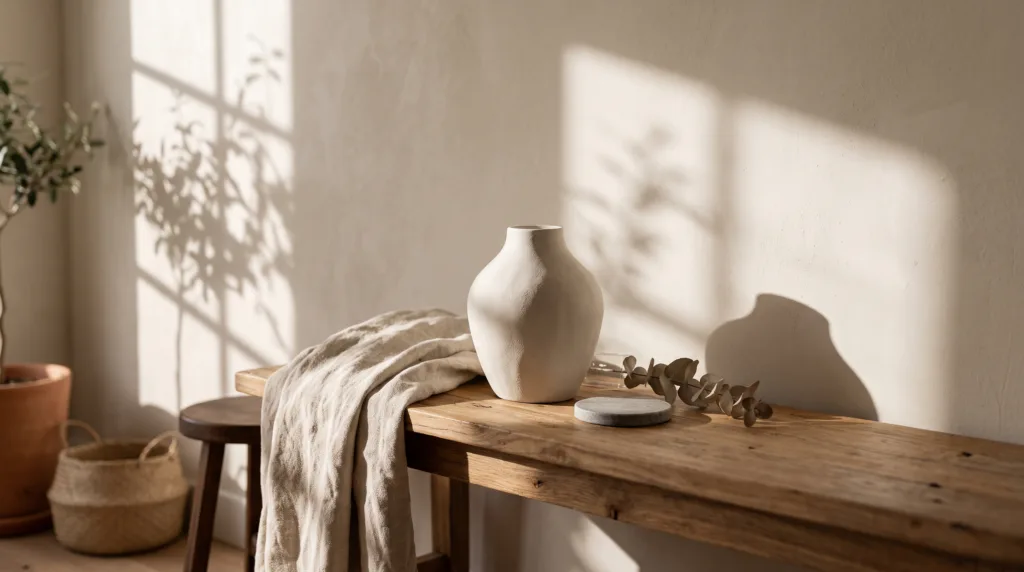
Home decor product video ideas work best when each clip shows scale, texture, placement, or a small transformation instead of simply rotating an object. For a useful phone-shot ad, choose one room problem, film five to eight steady details in natural light, and edit them into a 15- to 30-second story with one clear visual promise.
This guide is for small homeware brands, Etsy sellers, and makers who need practical ads without renting a styled house. You will leave with seven concepts, a repeatable shot plan, and export checks for vertical placements.
Why do home decor product video ideas work?
They work because decor is easier to understand in context. A still image can show a vase; a short sequence can show its height beside books, the glaze catching window light, and the difference it makes to an empty shelf. That sequence answers practical buying questions while building a mood.
Start with one promise per video: soften a bare corner, make a small table feel finished, organize an entryway, or add warm evening light. Avoid trying to show every color, dimension, and feature in the same edit. Specific stories are easier to film and easier to remember.
7 home decor product video ideas to try
1. The empty-to-styled corner
Lock the phone on a tripod or shelf. Record the empty corner, add the product, then add one supporting object. Keep the camera fixed so the change feels immediate. This is ideal for lamps, prints, cushions, planters, and small tables.
2. The texture tour
Film three close details: an edge, a surface, and a hand interacting with the material. Move slowly and let side light reveal grain, weave, glaze, or brushed metal. Finish with a wider view so viewers can connect the tactile details to the whole item.
3. One product, three placements
Show the same object on a shelf, bedside table, and desk. Match the framing and cut on the movement of placing it down. The concept demonstrates versatility without making unsupported claims. It also gives you three opening shots to test later.
4. The scale-check sequence
Put the product beside familiar room objects, then show it in a hand if practical. Do not rely only on a measurement graphic, because viewers may watch without reading. A mug, book, sofa arm, or doorway can provide visual scale while the product page carries exact dimensions.
5. Morning light to evening mood
Record the same composition twice: once beside a bright window and once with warm practical lights. This works especially well for lamps, candles, glassware, and reflective pieces. Lock exposure before recording each take so the phone does not brighten and darken mid-clip.
6. The useful ritual
Build a tiny story around normal use: hang keys on a tray, fold a throw over a chair, light a candle before reading, or place flowers in a vase. Show the action, the result, and a quiet final frame. Keep hands relaxed and movements slower than feels natural.
7. The impossible room variation
When you have a strong product photo but cannot restyle several rooms, create one restrained alternative scene rather than a chain of flashy effects. Keep the product shape, color, and proportions consistent. If AI alters a seam, handle, or material, discard the result.
For this step, you can turn a product photo into a short ad in Prodvid, our iOS app for AI product video ads. Its current App Store listing describes a workflow for uploading a product photo, choosing an effect, aspect ratio, and duration, then generating a video. Treat the output as a draft and compare every frame with the real item.
How do you shoot a home decor product video on a phone?
Use soft window light, a clean lens, locked focus, and repeatable camera positions. Then record a wide shot, a medium use shot, and several close details. The goal is not cinematic complexity; it is enough visual evidence to understand the item and imagine it at home.
- Choose one room problem. Write the change in a sentence: “This tray gives loose entryway items a home.”
- Clear the frame. Remove visible labels, cords, dust, and unrelated clutter. Keep one or two props that establish scale.
- Place the light. Start at roughly 45 degrees to a window. Turn off mixed overhead lighting if it creates conflicting colors.
- Lock the phone. Use a tripod, clamp, or stable stack of books. Tap and hold to lock focus and exposure when your camera app allows it.
- Record the sequence. Capture the before, placement, texture, use, and finished room. Hold each shot still for a moment before and after the action.
- Edit for one promise. Put the clearest result first, remove repeated views, and end on a clean product frame.
- Check the crop. Keep the product and important action away from interface areas at the edges.
If you want a reusable capture plan, adapt this 12-clip product video shot list. For alternate first seconds, pair the same footage with ideas from our product video hooks library.
According to TikTok Business (2026), 9:16 is the recommended vertical dimension for non-Spark in-feed ads, with at least 540 by 960 pixels. Shooting vertically from the start preserves more usable frame area than cropping a horizontal master later.
According to Meta’s Reels ad guide (2026), Instagram Reels ads use a 9:16 ratio and recommend 1440 by 2560 pixels. The guide also recommends leaving 14% at the top, 35% at the bottom, and 6% on each side free of important creative elements.
Copyable 20-second home decor ad script
Use this as a shot-and-voiceover template. Replace the bracketed details with language you can prove from the product itself.
0–3 seconds: Show the finished room. “The [room area] felt unfinished.”
3–7 seconds: Cut to the empty space. “I wanted one detail that added [visible quality].”
7–12 seconds: Place or use the product. “This [product type] brings in [material, color, or function].”
12–17 seconds: Show two close details. “Here is the [specific texture or construction detail] up close.”
17–20 seconds: Return to the wide result. “Now the corner feels [honest visual description].”
Keep subjective words tied to what the viewer can see. Replace “premium,” “perfect,” or “must-have” with concrete material, finish, construction, or use details.
FAQ
How long should a home decor product video be?
A useful starting range is 15 to 30 seconds. That is long enough for a result, two or three supporting details, and a final product frame. Shorten the edit if a shot repeats information. Keep a longer clean master so you can make platform-specific cuts without reshooting.
What background is best for decor videos?
The best background resembles a believable home while staying quieter than the product. Use a plain wall, wood surface, neutral fabric, or uncluttered shelf. Contrast matters more than matching: a pale ceramic piece needs enough tonal separation from a pale wall to keep its outline readable.
Should I show hands in a home decor ad?
Show hands when touch explains scale, texture, assembly, or use. Keep nails and sleeves simple, rehearse the movement, and enter the frame decisively. If hands add no information, leave them out and let placement, light, or camera movement carry the scene.
Can I film home decor videos without a styled room?
Yes. Build one tight corner with a wall, tabletop, and one scale prop, then crop closely. A foam board can bounce window light, while removable paper or fabric can change the surface. Viewers need a coherent slice of a room, not an entire professionally designed interior.
Key takeaways
- Give each ad one visible promise, such as adding warmth, order, texture, or scale.
- Film a result, a use moment, and close details instead of a simple product rotation.
- Use fixed framing for transformations and slow side-lit movement for texture.
- Shoot vertically and protect the interface-safe edges of the frame.
- Check AI-assisted scenes frame by frame against the real product.
Sources
- TikTok Business: About TikTok Auction In-Feed Ads, accessed October 2026.
- Meta: Instagram Reels Ads Guide, accessed October 2026.